AI
Tech
Feb 23, 2026
4 minutes


Hypercore’s AI Admin Agent is a new approach to loan administration for private credit. Instead of outsourcing operations to a traditional servicer that relies on manual processes and periodic reporting, funds work with our AI Admin Agent that combines AI execution, human oversight, and a modern platform to deliver loan administration as an outcome - faster, more transparent, and with full visibility.
Private credit has grown into a $3 trillion market. Fund sizes have increased, deal structures have become more complex, and portfolios have expanded considerably. Technology has transformed nearly every other part of financial services - and yet loan administration, the operational work that happens after a deal closes, looks remarkably similar to how it looked twenty years ago.
Most funds outsource this work to third-party administrators who handle onboarding, payment processing, reconciliation, covenant monitoring, investor reporting, and dozens of other operational tasks. These servicers employ large teams who manage these processes manually, supported by legacy systems built for a different era. The model has worked, but it has clear limitations.
We often hear from clients that speed is a persistent issue - simple requests like a draw, a payoff letter, or a data pull take days as email chains grow long and tickets sit in queues. Visibility is limited, as funds see their portfolios through periodic reports and monthly snapshots, meaning that when an LP has a question, the answer often requires a call to the servicer and a wait for someone to pull the data. Accuracy remains a challenge, with many funds maintaining shadow books - parallel spreadsheets to verify the servicer's calculations - because interest amounts don't match, fee allocations look off, and the numbers need to be checked, then checked again, then recalculated internally just to be sure. And transparency is constrained, since the outputs arrive but the underlying mechanics stay hidden in systems the fund can't access.
None of this is a criticism of the people doing the work. Admin agents employ smart, hardworking professionals. The problem is structural: manual processes, fragmented systems, and technology that hasn't kept pace with what's now possible.
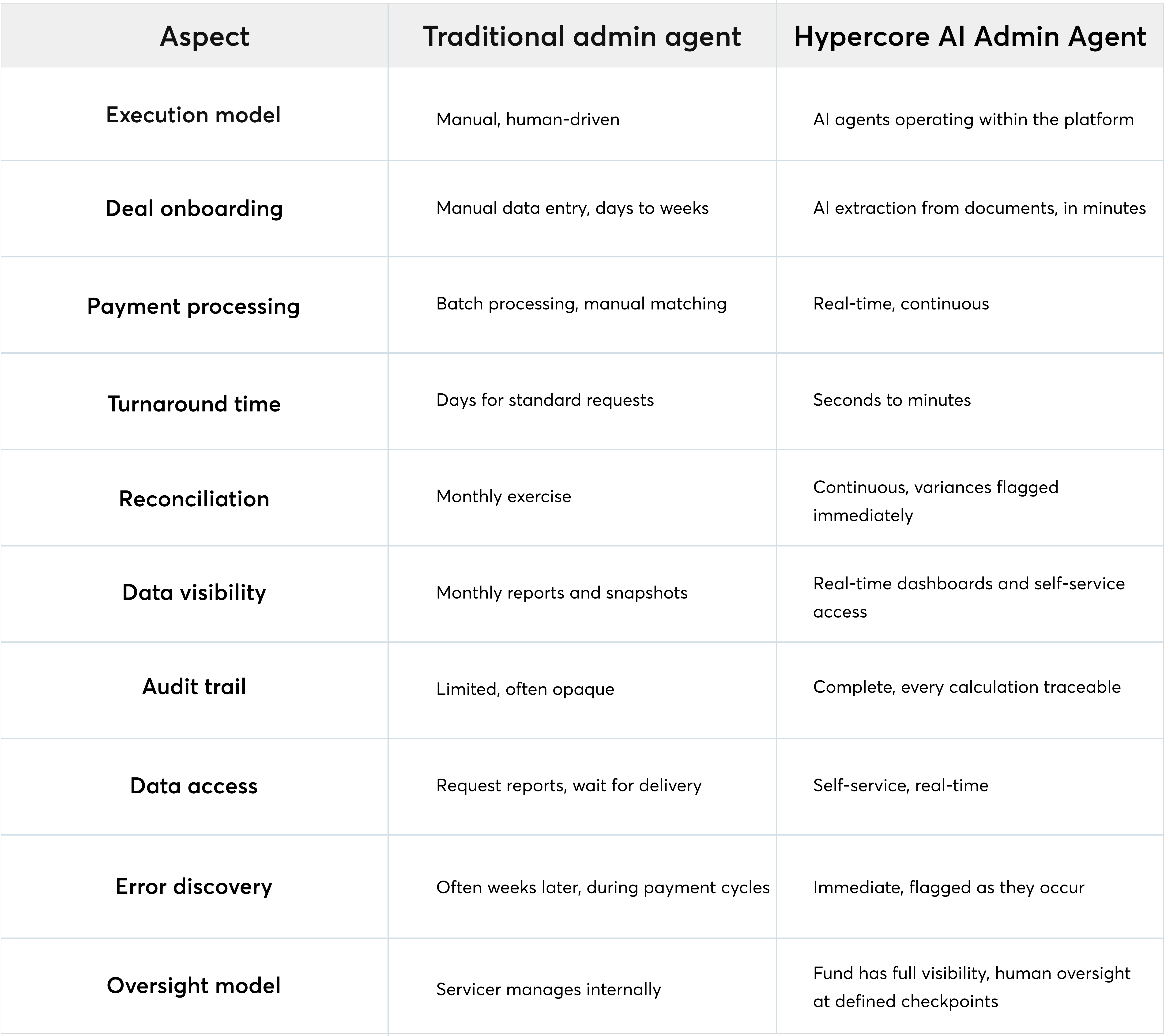
Traditional admin agents employ people who use systems to process work. Hypercore's AI Admin Agent inverts this model: AI agents handle the operational execution while humans provide oversight, manage exceptions, and ensure quality.
The fund receives finished work rather than managing a vendor relationship.
These terms get used interchangeably, but they describe fundamentally different approaches.
Workflow automation accelerates existing manual processes. It helps humans move faster through the same steps - automating handoffs, triggering notifications, routing approvals. But the work still requires human involvement at each stage. Hypercore's AI Admin Agent doesn't speed up manual work - it replaces it. AI agents take action and execute tasks end-to-end without requiring human involvement at every step - only where judgment and oversight are needed.
Copilots assist humans by drafting, suggesting, and summarizing. They advise; humans decide and act. A copilot might help an analyst draft a covenant compliance memo or suggest how to structure a waterfall. Hypercore's AI Admin Agent operates differently - the agents don't generate recommendations for someone to review and approve, they execute directly within the loan management system, performing operations the same way a human administrator would, with full audit trails for visibility.
Chatbots add a conversational interface on top of existing systems, allowing users to ask questions and get answers in natural language. Hypercore's AI Admin Agent isn't a chat layer - it's an operational engine embedded in the platform itself, executing against the underlying data model. The distinction is between answering questions about the portfolio and actually running the portfolio's operations.
The distinction matters because the outcomes are different. Automation and copilots make teams more productive within existing processes. An AI Admin Agent delivers the work itself.
The AI agents handle the full operational lifecycle of a loan - from deal close through payoff.
Deal onboarding and setup.Parse documents, extract terms, create stakeholders, configure accounts, build deal structures, charge fees, post to accounting, and notify all parties.
Ongoing servicing.Process payments, execute waterfalls, accrue interest, handle rate resets, manage draws, track reserves, reconcile cash, and post to accounting.
Covenant monitoring and compliance.Track deadlines, calculate compliance, identify breaches, monitor cure periods, and escalate exceptions.
Stakeholder communication.Payment notices, covenant reminders, investor reports - all automatic. Borrowers, lenders, and LPs access real-time data through portals.
Events and exceptions.Draw requests, payoffs, prepayments, breaches, defaults, restructurings - validated, processed, documented end-to-end.
Investor and LP servicing.Capital calls, distributions, position statements, K-1 support, and performance reporting - generated and delivered automatically.
Accounting and GL integration.Journal entries, EIR calculations, fee amortization, accruals, and period-end close - posted to accounting systems with full audit trails.
Reporting and analytics.Portfolio dashboards, cash flow projections, risk metrics, maturity schedules, and custom reports - real-time, self-service, exportable.
A reasonable question when considering this architecture: if AI agents are doing the work, what ensures accuracy? What about judgment? What about deal structures that don't fit standard templates?
It starts with the platform.
Hypercore's loan management software was purpose-built for private credit, not adapted from private equity or other asset classes. It already powers operations for leading funds across direct lending, ABF, specialty credit, and structured credit. Complex waterfalls, bespoke covenants, multi-lender facilities, non-standard fee structures, these aren't edge cases. They're what the platform was designed for, tested across thousands of loans.
Hypercore’s AI agents operate on this foundation, not a generic system learning as it goes, but infrastructure built for the full complexity of private credit from day one.
Then there's the human layer.
Hypercore's team oversees everything the AI agents do. Experienced professionals who understand private credit - the deal structures, the nuances, the moments that require judgment. They review outputs, handle exceptions, manage stakeholder relationships, and ensure the work meets the standard funds expect.
The AI agents themselves are designed to recognize their limits. Ambiguous language, unexpected patterns, unusual results - these get flagged for human review rather than processed automatically. The system is built to be conservative, escalating uncertainty rather than guessing.
Purpose-built software that handles complexity. Experienced humans who ensure quality. AI agents that execute at scale. Together, they deliver something none could achieve alone: loan administration that is fast, accurate, and trustworthy.
For funds accustomed to traditional servicing, several things change meaningfully.
Shadow booking becomes unnecessary. When calculations are transparent and auditable, there's no need to maintain parallel spreadsheets to verify someone else's math. The logic is visible, the audit trail is complete, and discrepancies can be investigated immediately rather than reconciled monthly.
Response times compress dramatically. What previously took days happens in seconds. AI agents don't have inboxes to clear or queues to work through. A question about a loan's current status, a request for a payoff letter, a draw submission - these are processed immediately rather than waiting for someone to get to them.
Data becomes current rather than historical. Portfolios reflect reality as it happens rather than as of last month's close. Dashboards update continuously. When an LP calls with a question, the answer is available immediately with data that's current to the minute.
LP conversations change character. Instead of "let me check with our servicer and get back to you," fund managers can answer questions directly, in real-time, with current data. This changes the dynamic of LP relationships - from reactive and delayed to informed and immediate.
Control returns to the fund. Data lives on a platform the fund can access, query, and build upon rather than being locked in a servicer's proprietary system. The fund owns their operational data and can use it however they need - for internal analysis, LP reporting, regulatory filings, or integration with other systems.
The fund team's role evolves. Instead of spending time chasing servicers, verifying calculations, and reconciling spreadsheets, fund operations teams can focus on exceptions, relationships, and strategic work. The AI Admin Agent handles the routine; humans handle what requires judgment.
The impact of an AI Admin Agent extends beyond operational efficiency - it represents a structural shift in how private credit is administered. When loan administration becomes continuous, transparent, and programmable, it transforms from back-office infrastructure into a strategic advantage. Funds can support increasingly complex deal structures without adding operational drag, respond to market events in real time, and provide LPs with visibility that reflects the sophistication of the asset class itself. In this model, administration is no longer a bottleneck to growth - it becomes the foundation that enables private credit to scale without scaling friction.


.png)