Competitive
Sep 1, 2026
3 minutes


Loan management software should help your team record transactions, manage changes to loan terms and track each fund’s share of a loan. If those activities still depend on parallel spreadsheets, the system may cover only part of your operational needs.
A repayment schedule is useful, but it cannot tell the whole story of a loan. Over its lifetime, a borrower may draw additional capital, make an early repayment, negotiate a different interest rate or extend the maturity date. Each event affects what your team needs to calculate, record and explain.
The question is how much of that work your software actually handles, and how much your team has to complete elsewhere.
Consider a loan whose interest rate changes halfway through the year, followed by a maturity extension three months later.
Your team needs an updated schedule, but it also needs to understand the sequence of events. What were the original terms? When did each change take effect? Which payments were made before the amendment, and which obligations remain outstanding?
If the process involves creating another schedule and explaining the differences in a spreadsheet, your team has two sets of records to maintain. The latest schedule shows the expected payments, while the spreadsheet explains how they got there.
That separation becomes difficult when someone needs to answer a question about an earlier period. A colleague reviewing the loan should be able to understand its history without relying on the person who made the changes.
When evaluating loan management software, ask the provider to demonstrate an amendment on an existing loan. Look for both the updated calculations and an accessible record of what changed.
Expected payments and actual payments serve different purposes. A schedule describes what should happen under the loan terms; transaction records show what has happened.
A borrower might pay early, pay only part of the amount due or make a payment that needs to be split between principal, interest and fees. Your team needs to record that activity and understand its effect on the outstanding balance and future obligations.
If the payment is recorded in one place and the schedule adjusted somewhere else, every transaction creates another opportunity for the records to drift apart.
A useful software demonstration should follow a payment through the process: enter the amount received, show how it is allocated and explain the resulting balance. It should also show how an incorrect entry is corrected while retaining a clear record of the adjustment.
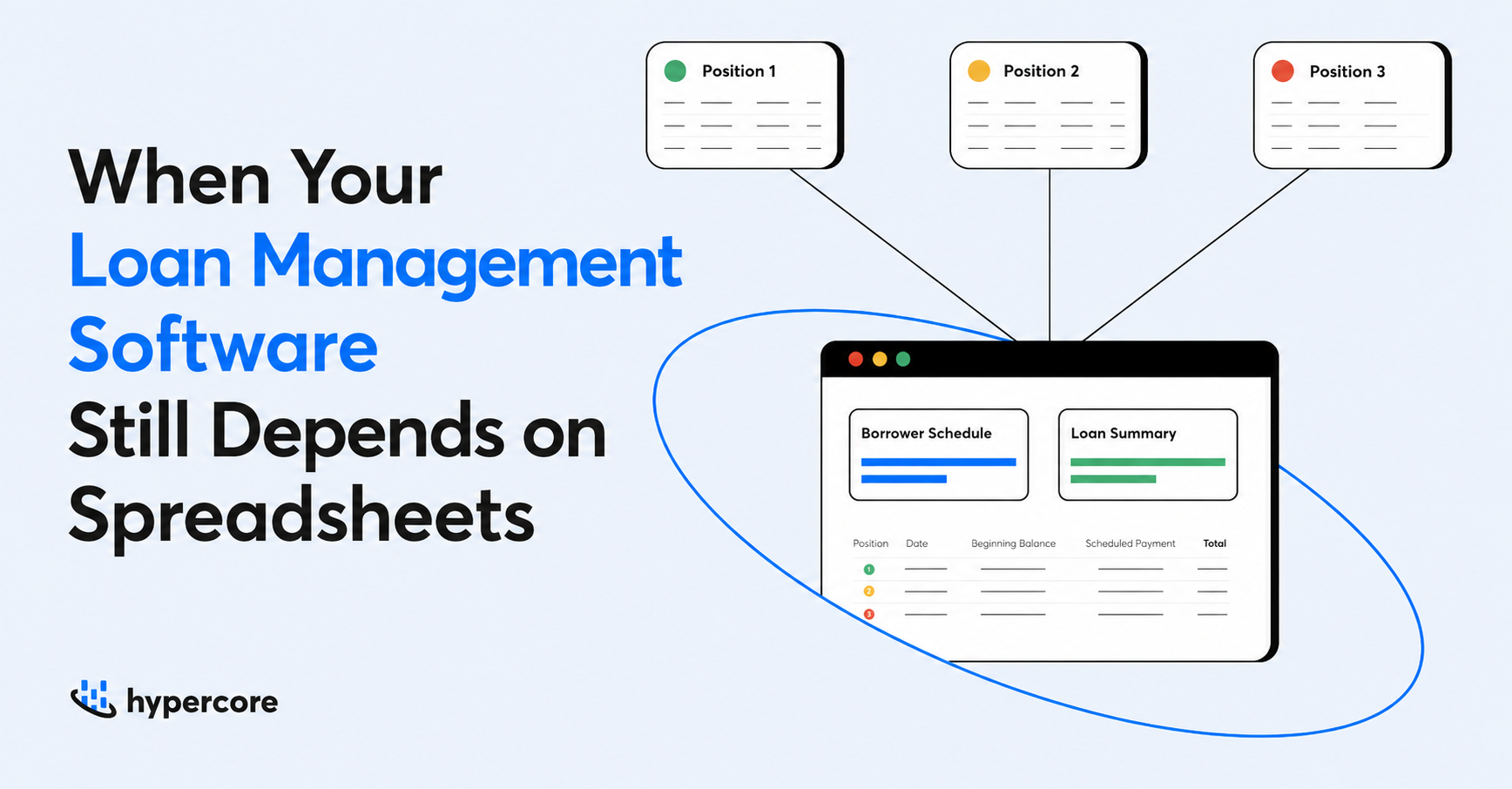
The operational challenge grows when more than one fund participates in a loan.
For example, suppose Fund A provides 60% of a loan and Fund B provides 40%. The borrower makes a principal repayment, then agrees to an extension.
The team needs to understand the effect on the overall loan and on each fund’s position. If each fund is maintained through a separate schedule, the same event may need to be entered several times and checked across several files.
The issue becomes more demanding when allocations change or particular fees belong to only one funding source. A simple percentage calculation may no longer capture the arrangement.
When reviewing software, ask whether funding sources are connected to the underlying loan. Then test a repayment and an amendment across those sources. The demonstration should make it clear where an update is entered, how it affects each participant and what still requires manual work.
Spreadsheets can be useful for analysis and planning. Their role deserves closer attention when they are needed to keep the official loan records complete.
Start with the files your team updates every week. Are they used to:
Those tasks provide a practical brief for evaluating a replacement. Instead of asking whether a provider has a particular feature, ask it to complete the work currently done in those files.
That makes the evaluation specific to your portfolio and gives your team a clearer basis for judging the potential improvement.
Hypercore brings loan activity, amendments and funding-source management into the same platform.
Teams can record repayments and other loan transactions, including capitalization and early redemption. Its transaction tools also support corrections; editing a transaction reverses the original entry and creates an updated one. Hypercore’s loan actions guide explains these workflows.
For changes to loan terms, Hypercore supports schedule updates, amendment tracking and approval workflows. This helps teams manage the change alongside its effect on the loan, with an audit trail available for review. Learn more about Hypercore’s loan servicing capabilities.
Hypercore also tracks funding-source allocations and calculates returns within a unified schedule, supporting visibility across the loan and its funding sources. This is particularly relevant for teams maintaining separate schedules for participating funds or investors. See how Hypercore manages funding sources.
The value to assess is how much repeated entry, checking and explanation your team can remove from its everyday work.
Choose a loan with a history that reflects your portfolio: a rate change, an extension, a partial repayment and more than one funding source.
Ask the provider to walk through those events and show the resulting loan balance, payment schedule, amendment history and fund allocations. Then ask what work would still take place outside the platform.
A successful demonstration should leave your team able to explain both the current position and how it developed.
Explore Hypercore’s loan management platform and bring a representative loan to the conversation. We can walk through the workflows your team currently manages across schedules and spreadsheets.
A loan schedule sets out expected payments based on loan terms and assumptions. Loan management software can also record actual transactions, manage amendments, track funding sources and support reporting. The capabilities included vary by provider and configuration.
It can reduce reliance on spreadsheets for routine servicing when the platform supports the necessary calculations, transactions, allocations and reporting. The practical test is whether your team still needs a parallel spreadsheet to keep the loan record complete.
Use the same representative loan and events in both systems. Compare the steps required, the information retained and the work left outside each platform. Include amendments, repayments and multiple funding sources where these are relevant to your portfolio.

Tech
Thought Leadership
Oct 8, 2026